
Case study · B2B SaaS SphereOne.ai — one workspace, seven product surfaces
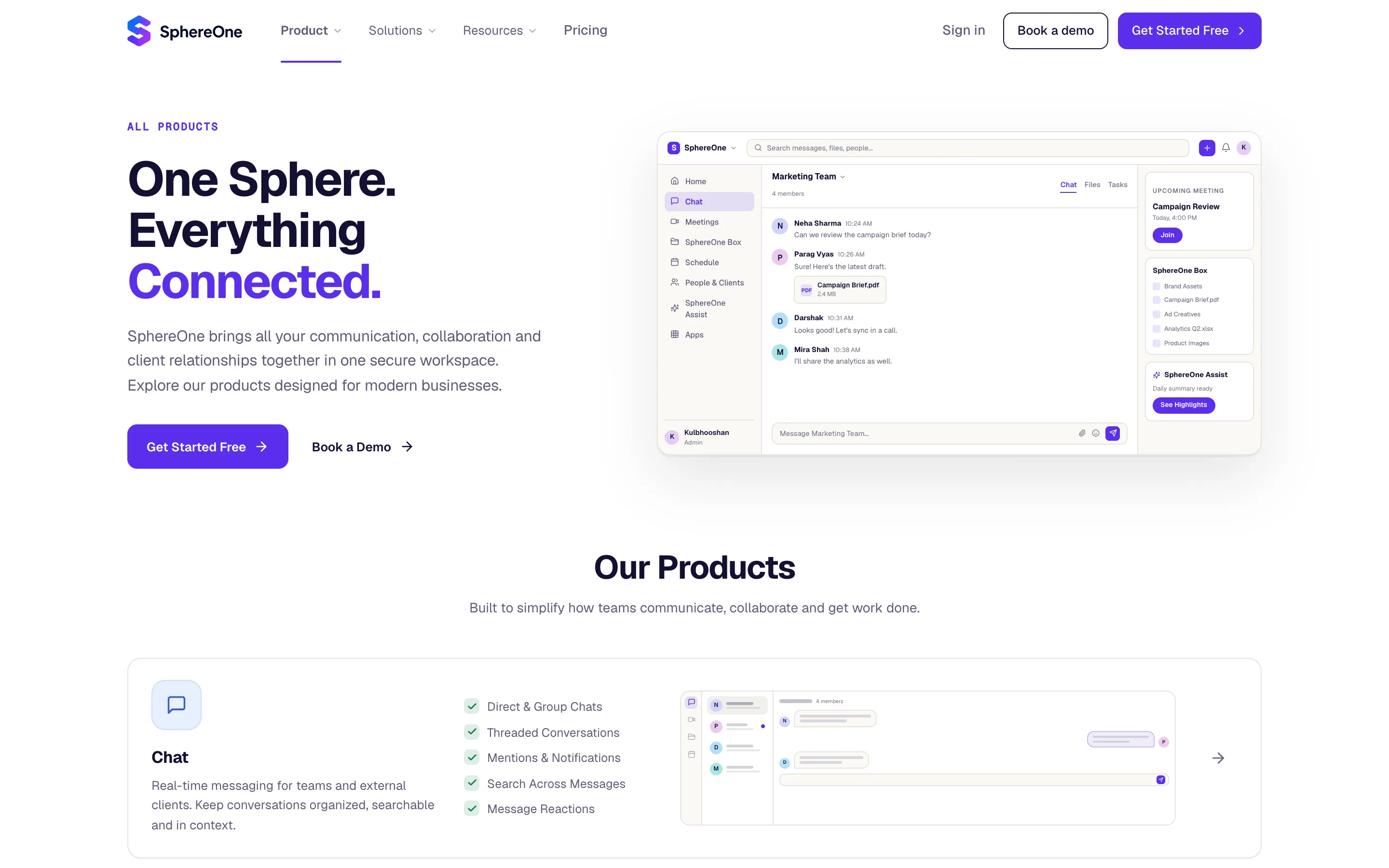
We built SphereOne.ai end to end: messaging, meetings, files, scheduling, a client directory, the permission model underneath all of it, and an AI assistant — one coherent product rather than seven tools bolted together. It is live, and you can go and use it.
01 · The brief
B2B SaaS · Multi-tenant · Delivered
Seven tools, seven ideas of what a team is.
Collaboration suites usually grow by acquisition: chat from one vendor, video from another, storage from a third, each with its own identity model and its own idea of what a 'team' is. The result is a product where a permission granted in one surface does not mean the same thing in another — which is fine until an enterprise buyer asks a security question. The brief was to build the whole surface area once, on one identity and permission model, so that a single answer holds across every part of the product.
At a glance
- Product surfaces
- 7
- Access model
- RBAC
- Tenancy
- Multi
- Engagement
- Delivered
02 · The architecture
One identity and permission model underneath everything.
Seven surfaces. One answer to “who can see this”.
Every surface resolves through the same role-based access model — specified before a single feature was written. That is the decision the rest of the product hangs off, and the reason an enterprise security questionnaire can be answered once rather than seven times.
- Permission model
- 1
- Real-time transport
- 1
- Surfaces resolving through it
- 7
Every request, from every surface, resolves through the same model.
03 · The approach
The decisions the rest of the product hangs off.
How it was built.
One permission model, defined before any feature
Role-based access control was specified first and every surface was built against it, rather than each feature inventing its own sharing rules and reconciling later. This is the decision that makes the rest of the system explainable: 'who can see this file' and 'who can see this message' resolve through the same path.
Real-time as infrastructure, not a feature
Threaded messaging, presence, typing state and live document activity all run over shared real-time transport with a single reconnection and offline-replay strategy. Building this once meant each new surface inherited it instead of re-implementing a slightly different version.
Media handled as a pipeline
HD meetings with recording and transcription are a pipeline problem, not a UI problem: capture, storage, post-processing, transcript generation, then indexing so the content becomes searchable alongside messages and files. Treating it as a pipeline kept the recording feature from becoming an island.
AI assistance wired to the permission model
Summarisation, smart search and drafting only ever operate over content the requesting user is already entitled to see. That constraint was applied at the retrieval layer rather than trusted to the prompt, because a permission boundary enforced in a prompt is not a permission boundary.
A permission boundary enforced in a prompt is not a permission boundary.
From the build
04 · Surfaces delivered
07 product surfaces
Built once, on one model.
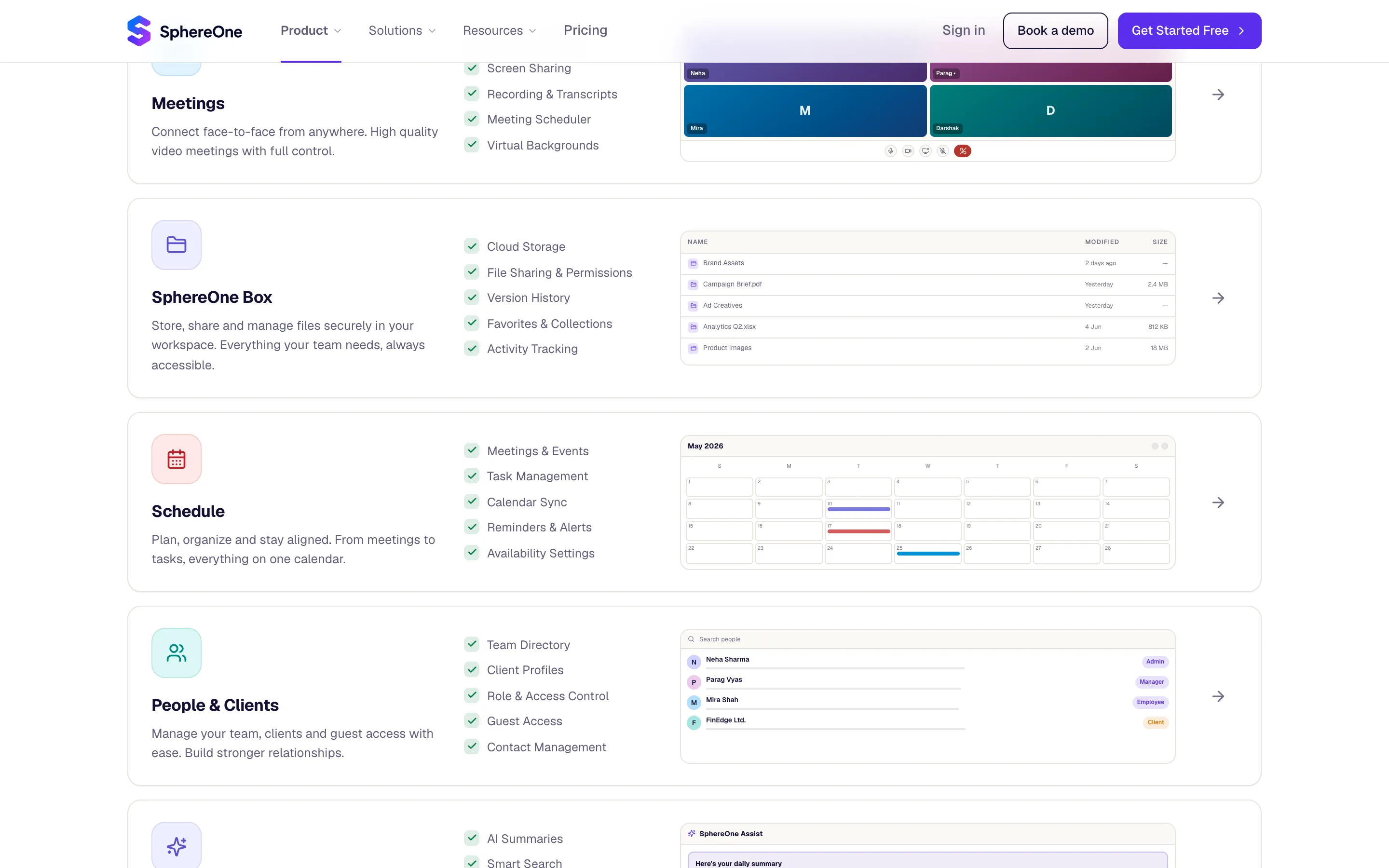
- MessagingThreaded real-time chat with mentions, reactions and full-text search across history.
- MeetingsHD video with screen sharing, recording and automatic transcripts.
- File storageGranular sharing permissions and version history.
- SchedulingCalendar, tasks and reminders unified across the workspace.
- DirectoryPeople and client records with role-based access control.
- PermissionsOne role-based model every other surface resolves through, rather than per-feature sharing rules.
- AI assistantSummaries, smart search and drafting, scoped to the user's own permissions.
05 · What it produced
What the client has now.
- A single product where one permission answer holds across every surface
- Real-time transport, media pipeline and search built once and shared by all features
- An architecture that can answer an enterprise security questionnaire without caveats per module
Stack
Note on compliance: SOC 2, HIPAA readiness and uptime commitments published by SphereOne.ai belong to that platform and its owner. Averis Global Solutions makes no such claim about itself.